Next Generation Offshore Wind Logistics

Transport & Installation of offshore wind turbines
FEEDERDOCK is a game changing development for the global offshore wind sector, addressing all future technical challenges arising from technology development of foundation structures and wind turbines. The solution unlocks groundbreaking costs saving potentials enabled through its unrivalled productivity advantage.
The Advantage
- The feeder solution performs 30-50% faster than conventional methods (HLJV commuting between site and port)
- Performance benefits increase with growing distance between site and port and number of WTGs
Increasing efficiency in turbine installation
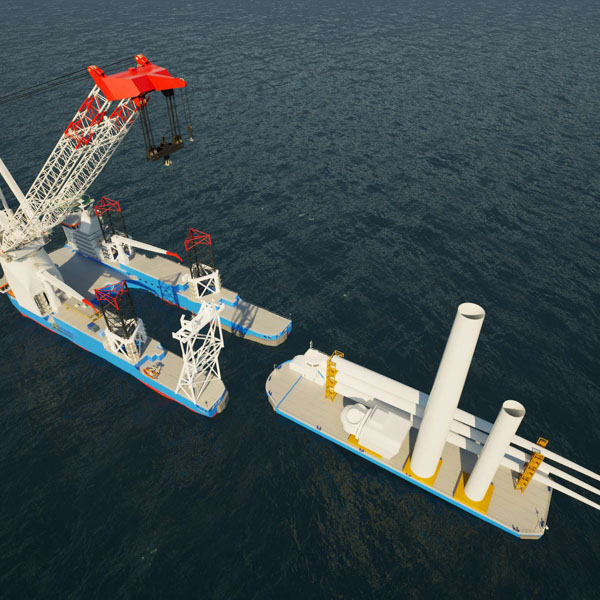
The FEEDERDOCK Solution
- Heavy lift jack-up main vessel
- Feeder vessels transporting components
- Fixed-to-fixed installation method
- Continuous feeder process
Productivity advantage
- The feeder solution performs 30-50% faster than conventional methods (HLJV commuting between site and port)
- Performance benefits increase with growing distance between site and port and number of WTGs
Commercial advantage
- Superior installation performance
- Earlier power feed-in (early completion revenues)
- Reduced cost of interest during construction of the OWF
- Reduction in project costs (spread, port logistics, project teams)
Technical advantage
- Flexible to install both foundations and wind turbines
- World-class main system suppliers integrated
- Solution provides highest workability under broad wave spectrum, proven by tank tests (hs, wave period)
- Strong sheltering effect by main vessel enables smooth feeder docking process and grants high operational robustness
- State-of-the-art design supported by incorporation of European Learning Curve of project partners (15 yrs of HLJV design, construction, operation)
Infrastructure advantage
- Small, light-draft feeders replace conventional large heavy lift jackup vessels to enter ports, translating into minimum infrastructure- & port requirements
- Enabling port utilization also in rural areas due to minimum draft requirements of the feeder vessels (6.5m)
- Reduction of extensive CAPEX investments in port build-out measures
Project Partners